 |
|
| |
|
OceanSide church of Christ
 Previous Previous |
Return to Sermons |
Next  |
 |
 |
QUESTIONS & ANSWERS (121)
Victor M. Eskew
INTRODUCTION
A. When a person engages in Bible study, there are many questions that he can ask as he goes through the process?
1. What type of study do I want to do?
2. What is the meaning of this word?
3. How does this verse apply to the reason a book was written?
4. How does this verse relate to other verses on the same subject?
5. What lessons can I learn from this verse?
B. Notice that questions usually cause people to search.
1. They search for answers to their questions.
2. If they find the right answers, their knowledge is increased.
3. If they find the right answers, their lives are enriched.
C. We have been doing Q&A lessons for many years at OceanSide. We are a little late this month due to other circumstances, but we do not want to skip a month. Let’s look at three questions in this lesson.
I. QUESTION #1: Drifting from the Scriptures
A. Stated: What are the most common reasons people drift from Scripture today?
B. Answer:
1. They do not understand and appreciate the divine authority of God’s Word.
a. The evidence of the authority of God’s Word:
1) The world was created by “the word” of God (Gen. 1:3). “And God said, Let there be light…”
2) The word of God came to the patriarchs (Gen. 6:13). “And God said unto Noah…”
3) The word of the Lord, also known as the commandments of the Lord, governed Israel of old (Deut. 4:2).
4) The prophets often began their prophecies with this phrase: “Hear the word of the Lord” (1 Kings 22:19; 2 Kings 7:1; 2 Kings 20:16).
5) Jesus, the Son of God, is referred to as “the Word” (John 1:1, 14).
6) Jesus promised that His words would be revealed to the apostles by the Holy Spirit (John 14:26).
7) Jesus proclaimed that one of the tests of discipleship was to continue in His word (John 8:31).
8) The Word is not to be added to or taken from (Rev. 22:18-19).
9) The Word will judge us on the last day (John 12:48).
b. When many, including Christians, hold this book, the Word of God, in their hands, they do not appreciate the fact that it comes from God’s mind, was revealed by a divine Spirit and is the only authority God has given to man.
2. They do not have a love for the Scriptures.
a. Psalm 119:97
O how love I thy law! It is my meditation all the day.
b. The word “love” means “to have an affection for.
c. These individuals acknowledge God’s Word, but they do not adore it.
d. They do not think about it.
They do not yearn for it.
Their hearts do not ache when they are away from it.
Their minds do not anticipate that time when they will read and meditate upon it again.
3. They have not truly studied the Scriptures.
a. The Bible teaches us to study God’s Word (2 Tim.2:15).
b. Without study, there is no knowledge.
c. In Hosea 4:6, God declares: “My people are destroyed for lack of knowledge.”
4. They want outcomes that they do not believe the Scriptures can give them. (Ex., King Jeroboam disregarded God’s Word because he was fearful that if Israel went back to Jerusalem to engage in the feast days, they would reunite with the Southern Kingdom, 1 Kings12:26-29, esp. v. 27).
If this people go up to do sacrifice in the house of the Lord at Jerusalem, then shall the heart of this people turn again unto their lord, even unto Rehoboam king of Juda, and they shall kill me, and go again to Rehoboam king of Judah.
5. They want to live lives that are different than the one prescribed by the Bible.
a. The Bible teaches us how to live.
1. “For to me to live in Christ…” (Phil. 1:21)
2. “…we should live soberly, righteously, and godly, in this present world” (Tit. 2:12).
b. We have these words to a hymn: “Live for Jesus, O my brother, His disciple ever be. Render not to any other, what alone the Lord’s should be.”
c. They want to live for self.
They want to engage in some sin.
They want to gain worldly success.
They want to have the approval of man.
6. They believe “life,” that is, daily life, trumps the demands of Scripture: work, school, family, even sports and recreation.
a. Life is immediate. Life calls for attention. Life will pass you by. Life promises a lot of happiness and joy. Life doesn’t allow for alternatives. Life does not appear to be confining. Life doesn’t seem to insist on sacrifice. Life rewards quickly. Life says a person can have it his/her way. Life convinces the individual that it needs him/her.
b. In many ways, a person’s spiritual life is almost the opposite of everything we just mentioned.
c. Spiritual life is described much differently than our physical lives.
1. Life in light (John 8:12)
2. Abundant life (John 10:10)
3. Newness of life (Rom. 6:4).
4. A life hid with Christ in God (Col. 3:3).
5. Christ is our life (Col. 3:4)
6. Eternal life (John 10:28).
II. QUESTION #2: Mission Work: Philippines
A. Stated: What mission work will we be supporting in April with our contributions over budget?
B. Answer:
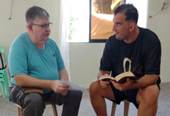
1. We will be supporting the mission work conducted by Michael and Deborah Stock in the Philippines.
a. Picture of the Philippines

b. Michael and Deborah Stock


c. The work is going well with conversions happening regularly.


2. One concern: OceanSide is becoming smaller and smaller.
1. Death has taken several of our loved ones.
2. Thus, it is going to be more difficult to meet and surpass our budget each week.
3. We want to remind all of us of an example of generous giving found in 2 Corinthians 8:1-3.
Moreover, brethren, we do you to wit of the grace of God bestowed upon the churches of Macedonia; how that in great trial of affliction, the abundance of their joy and their deep poverty abounded unto the riches of their liberality. For to their power, I bear record, yea, and beyond their power they were willing of themselves.
Struggles Attitudes Giving
Great trial of affliction Abundance of their joy Abounded
Deep poverty Willing of themselves Riches of their liberality
Beyond their power
4. If we will follow the example of the Macedonians, we can continue to contribute to many good works, like the Philippines, throughout the remainder of this year.
CONCLUSION
A. We have examined two questions in this lesson.
B. Remember questions are often designed to cause us to search.
1. We have to go to places and people to get answers.
2. Once we have those answers, we have to consider them and weigh them carefully.
3. Once we have the correct answer, our knowledge increases.
a. Knowledge is power.
b. Knowledge keeps on from being destroyed.
c. Knowledge makes a person more useful.
C. Keep asking your questions. We will continue to have our Q&A lessons once each month.